Before We Were Bengali — The People of the Red Earth
There is a moment, traveling west from Kolkata by train toward Bardhaman or Bolpur, when the landscape changes without warning. The alluvial green of the Ganga delta — flat, water-saturated, the colour of rice paddy and pond weed — gives way to something older and harder. The soil turns ochre. Then terracotta. Then a deep, oxidized red. The land lifts slightly. Laterite boulders appear at the edges of fields. The air smells different: drier, with something mineral in it.
This is Rāṛh. The upland belt that stretches across Birbhum, Bankura, Purba and Paschim Bardhaman — the western edge of Bengal where the Chota Nagpur Plateau begins to assert itself against the plain. In Bengali, রাঢ় (Rāṛh) refers to this zone specifically: the pre-delta, the old land, the place where the rivers run clear over laterite rather than silty over alluvium.
A digression that is actually relevant: earlier this year I visited Hampi and Chitradurga in Karnataka with family — wife, children, sister, brother-in-law, the lot. In that region, some of the world’s oldest granite and red laterite dust coexist within a few kilometres of each other. I confess the Vijayanagara monuments did not fully hold my attention. I had geology on my mind. The granite there is among the oldest on earth — a Precambrian basement shared, remarkably, between peninsular India and Australia, relics of the ancient supercontinent Gondwana. That granite, through billions of years of intense sun and monsoon rain, has been weathering into iron- and aluminium-rich red dust.
The Rarh of Bengal is red for the same reason — but because the rainfall is heavier here, the silica has been washed away, leaving only the iron and aluminium behind. That is why laterite has that characteristic puffed, friable texture, like a mineral papadum. The geological connections with Karnataka run deep; the differences are real too, and belong in a different story.
It is also the oldest inhabited landscape in Bengal.
That red soil the train passes through is not background scenery. It is the floor of a 3,600-year-old civilization. And the people who built that civilization — who farmed the same grain we eat today, who left their words folded into our language — were not Bengali. But they made Bengali possible.
The Mound on the Ajay
The Ajay River runs east through Bardhaman before joining the Bhāgīrathī. Somewhere around 1600 BCE — before the Mahābhārata was composed, before Magadha existed, before Buddhism — a community of rice farmers established themselves on its banks in what is now Purba Bardhaman district.
They left a mound.
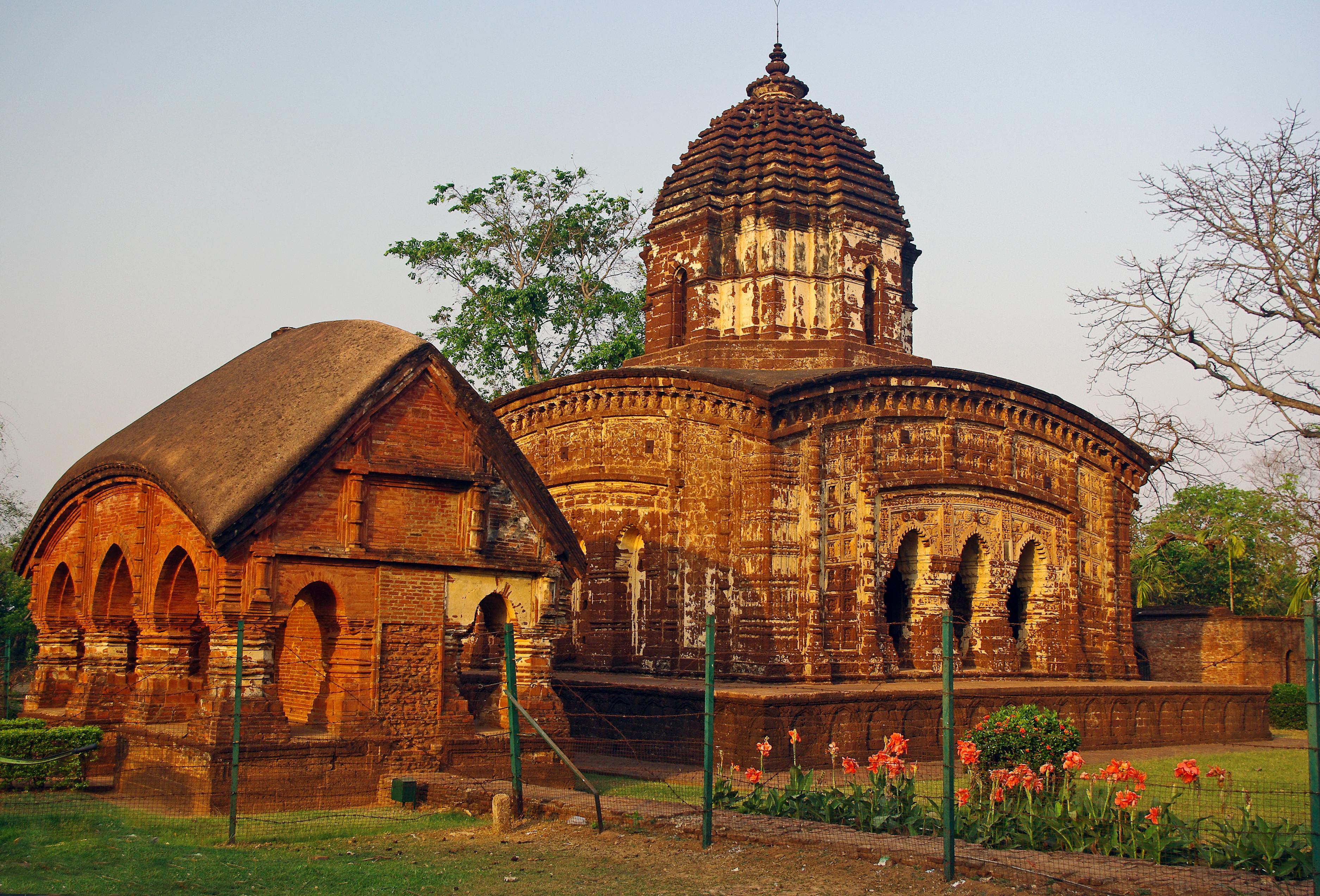

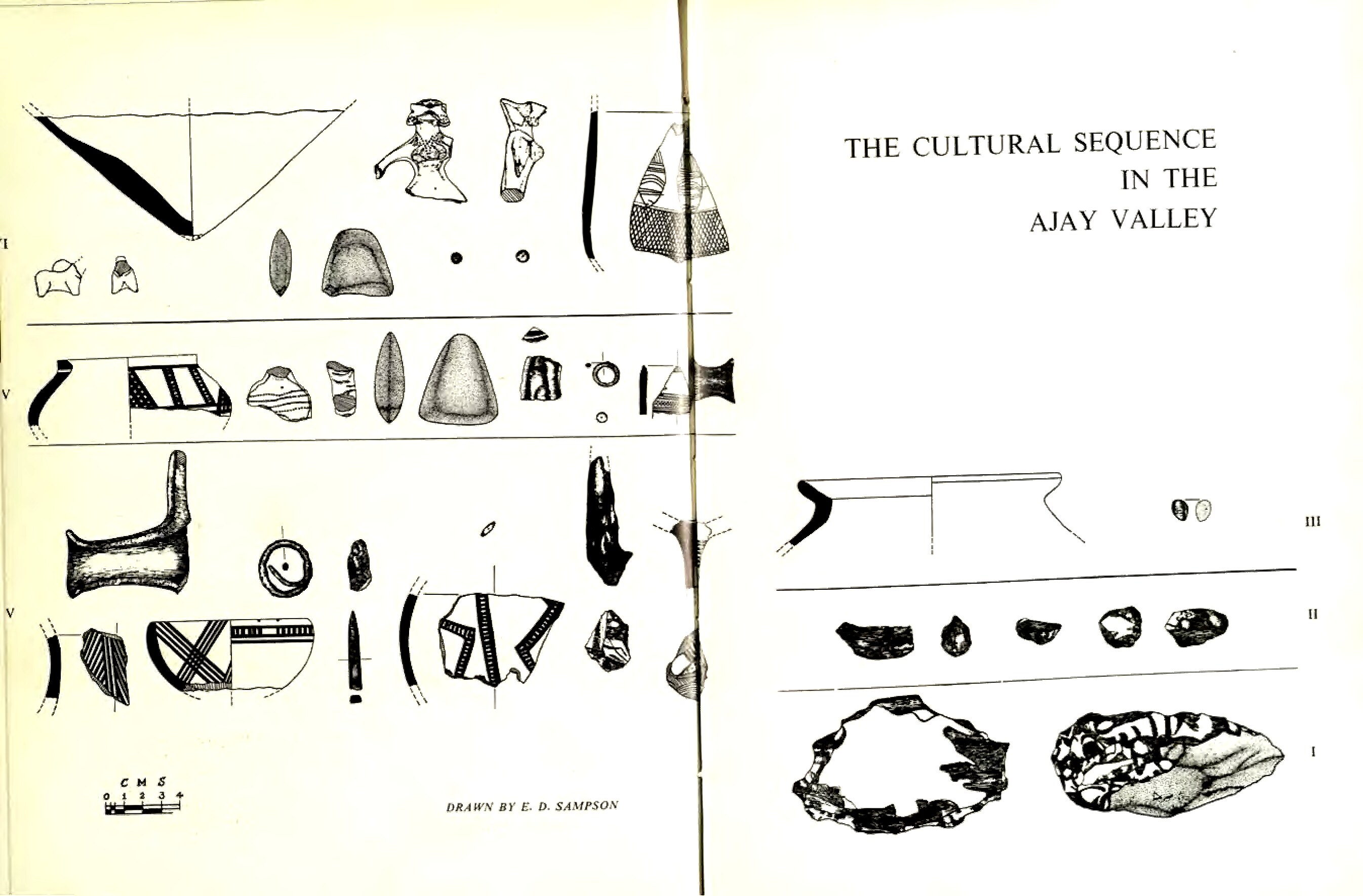
পাণ্ডু রাজার ঢিবি (Pandu Rajar Dhibi, “the mound of King Pandu”) was first systematically excavated between 1962 and 1965 by the archaeologist Paresh Chandra Das Gupta. What he found there changed how historians understood western Bengal’s antiquity. This was a Chalcolithic site — “Chalcolithic” meaning copper-using, pre-iron — with occupation layers dating from roughly 1600 BCE onward.
The material culture was specific and coherent. Pottery was black-and-red ware: vessels fired so that the interior and upper portion came out black while the body remained red, decorated with painted motifs of starfish, ladders, and triangles. Alongside the pottery: copper bangles, copper fishhooks, copper needles. Bone tools. And crucially — rice husk impressions pressed into the clay walls of storage vessels, left there either by accident or by deliberate tempering with rice chaff.
That rice. The same grain. The same species — Oryza sativa, the domesticated Asian rice that feeds two billion people today. The people of Pandu Rajar Dhibi were growing it, processing it, storing it, and pressing its husks accidentally into their pots more than three and a half millennia ago.

Pandu Rajar Dhibi was not unique. Subsequent surveys have identified 76 Chalcolithic sites across the Rāṛh zone — along the Ajay, the Damodar, the Kopai, and their tributaries. This was not a single village. It was a regional culture: a networked rice-producing civilization spread across the laterite uplands of western Bengal, doing something remarkably consistent across a large territory for several centuries.
Who Were These People?
This is where archaeology has to work harder, and where honesty about the limits of evidence matters.
Excavations at Pandu Rajar Dhibi recovered skeletal remains — fourteen individuals, enough for morphological analysis. The researchers who studied these remains reported affinities with modern Santal and Saora populations. This is the researchers’ interpretation, and it should be held with appropriate care: skeletal morphology is an imprecise tool for population affiliation, and the sample size is small. But it is the best physical evidence we have, and it points in a consistent direction.
The Santal people — the Santali-speaking community now primarily concentrated in Jharkhand, Odisha, West Bengal, and Bangladesh — are an Austroasiatic-speaking group. Their language belongs to the Munda branch of the Austroasiatic family: the same broad family as the Mon and Khmer languages of mainland Southeast Asia, though the Munda branch separated from its Southeast Asian relatives thousands of years ago. The Saora (also called Sora or Saura) are a related Austroasiatic community in Odisha — their language is Munda-branch too, though a distinct one from Santali.
If the skeletal analysis holds, the people at Pandu Rajar Dhibi were ancestrally related to communities whose descendants still live in this landscape today. When you see a Santal family in the weekly market at Bolpur, or a Munda woman carrying paddy near Purulia, you are looking at a thread that may run continuously back three and a half millennia. Not their direct descendants — populations mix, migrate, layer over one another — but something connected. Some of the same genes. Some of the same practices. The same rice.
The Genetics: A Migration by Sea
Population genetics in the last two decades has sharpened this picture considerably — while also adding a detail that is, frankly, astonishing.
Studies of Y-chromosome lineages (inherited from fathers to sons) across South Asian populations have identified a haplogroup designated O1b1a1a — previously known by different designations as nomenclature evolved. This is a Southeast Asian male lineage. It is strongly associated with Munda-speaking populations across South Asia, and it is rare to absent in communities without Munda ancestry.
Where does this lineage enter the Indian subcontinent? The linguist Paul Sidwell, synthesizing linguistic and genetic evidence, proposed in 2018 that the Munda ancestral population arrived on the Odisha coast — not overland from the northwest like the Indo-Aryan speakers, not from the northeast like Tibeto-Burman groups — but by sea, from mainland Southeast Asia, around 2000–1500 BCE.
By boat. Across the Bay of Bengal.
This is contested, and I want to be clear about that: the sea-arrival hypothesis is plausible and consistent with the genetic distribution, but it is not unanimously accepted. Linguists and geneticists continue to debate the routes and dates. What is well-established is the Southeast Asian male lineage among Munda speakers, and what is well-established is that it arrived from the east, not the west.
There is another piece of this genetic picture that matters for understanding Bengal’s social stratification. The ANI/ASI framework — “Ancestral North Indian” and “Ancestral South Indian,” a simplified model of South Asian genetic ancestry developed by Reich and colleagues — reveals a striking gradient within Bengali populations. Bengali Brahmins show higher ANI proportions. Bengali Dalits, lower-caste communities, and particularly populations from the eastern delta show higher Ancestral South Indian proportions and higher frequencies of O1b1a1a. The people who came later — the Indo-Aryan speakers, the Brahmanical order — are genetically layered over an older substrate. And that older substrate is still there, in the bodies of people who are often the most economically marginalized.
The genetics is not subtle about who the ancestors of Bengal’s lower castes are. They are the descendants of the people who were already here.
Their Words in Our Mouths
Now comes the part that I find most affecting.
Historical linguists studying the Munda substrate in Bengali and other eastern Indo-Aryan languages have identified a set of words that appear to be borrowings from pre-Aryan Austroasiatic speakers. These are words for things you need words for when you are actually living in a landscape: tools, animals, plants, the rhythms of agricultural life.
ঢেঁকি (dheki, “rice-husking lever”) — the traditional foot-operated tool for dehusking rice. Cognates appear in Munda languages: Mundari ḍheṅki, Santali dheṅki. This word traveled into Bengali not from Sanskrit (which has its own vocabulary for rice processing — ulūkhala for the mortar, musala for the pestle) but from the people who were processing rice in the Rāṛh before Sanskrit speakers arrived.
ডাঙা (danga, “raised ground, highland”) — the word for the dry, elevated land distinct from the waterlogged paddy fields. Santali ḍaṅgra, Mundari ḍaṅgā. A topographic vocabulary built by people who needed precise words for this specific landscape — the laterite uplands of the Rāṛh — and whose words Bengali absorbed when it arrived.
I should be precise here: the linguistic argument for a Munda substrate in Bengali is well-established in general terms — Suniti Kumar Chatterji documented it, Southworth expanded it — but tracing individual words to specific source languages is often contested. Some proposed Munda borrowings have competing Sanskrit or Dravidian etymologies. The honest claim is not “this word definitely came from the Chalcolithic farmers of Pandu Rajar Dhibi” but rather: some of the words Bengali uses for agricultural tools and practices appear to be very old borrowings from Austroasiatic-speaking populations, and the Chalcolithic Rāṛh farmers were almost certainly Austroasiatic-speaking.
The words for how to feed yourself may be the oldest stratum of Bengali’s vocabulary.
The Conflagration, and What Came After
Period III at Pandu Rajar Dhibi ends badly. Excavators found clear evidence of a major conflagration — burning intense enough to leave a distinct layer in the stratigraphy. After this event, copper disappears from the material record and iron appears in its place. The pottery traditions change. There is an archaeological discontinuity that is hard to explain as gradual cultural evolution.
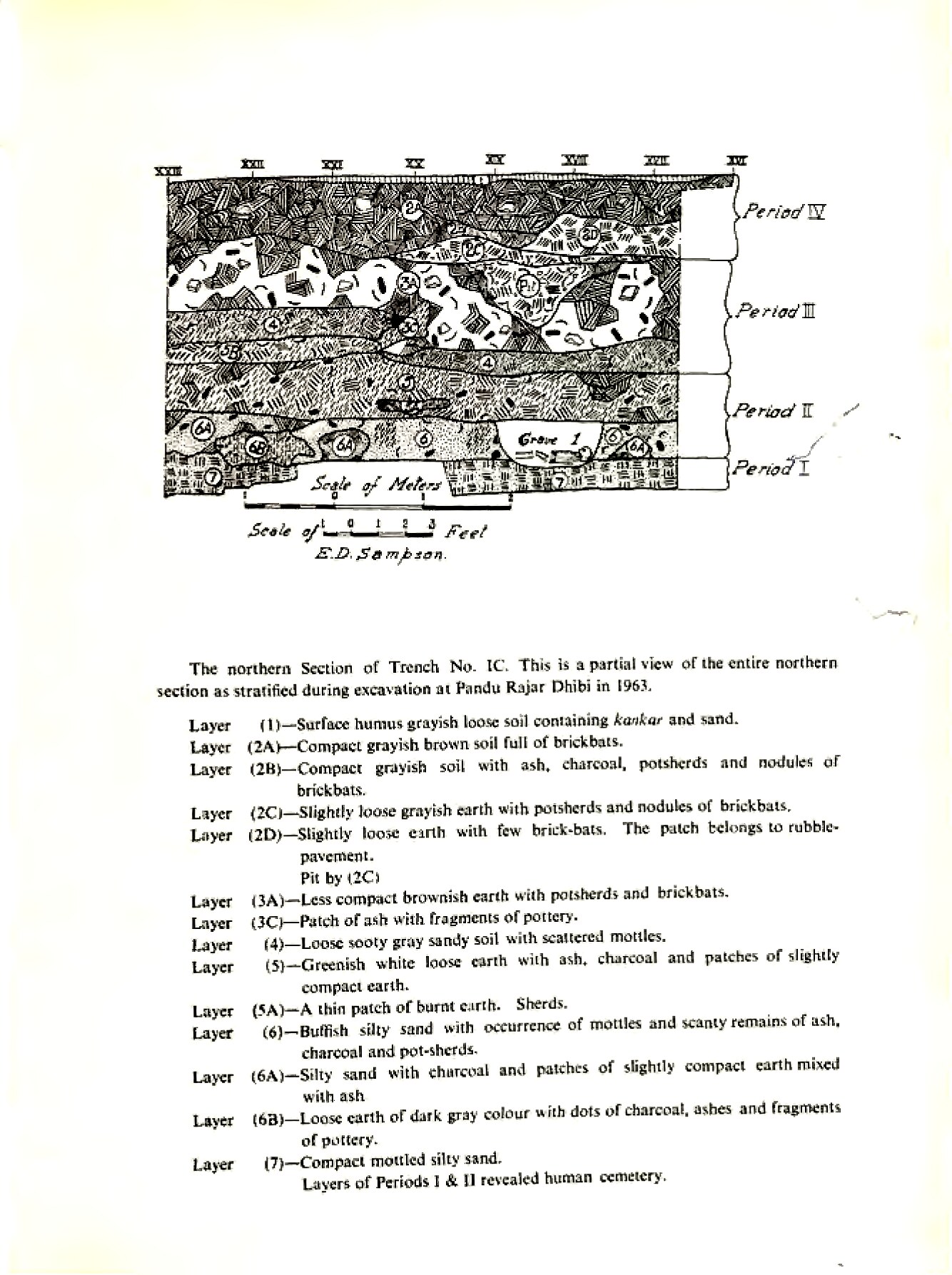
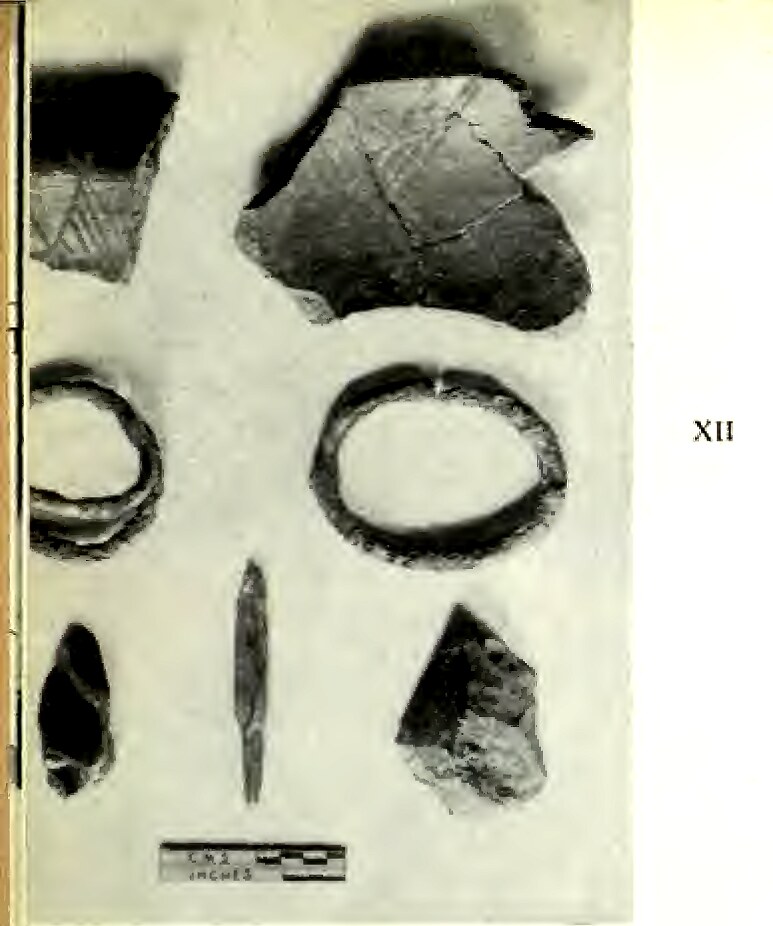
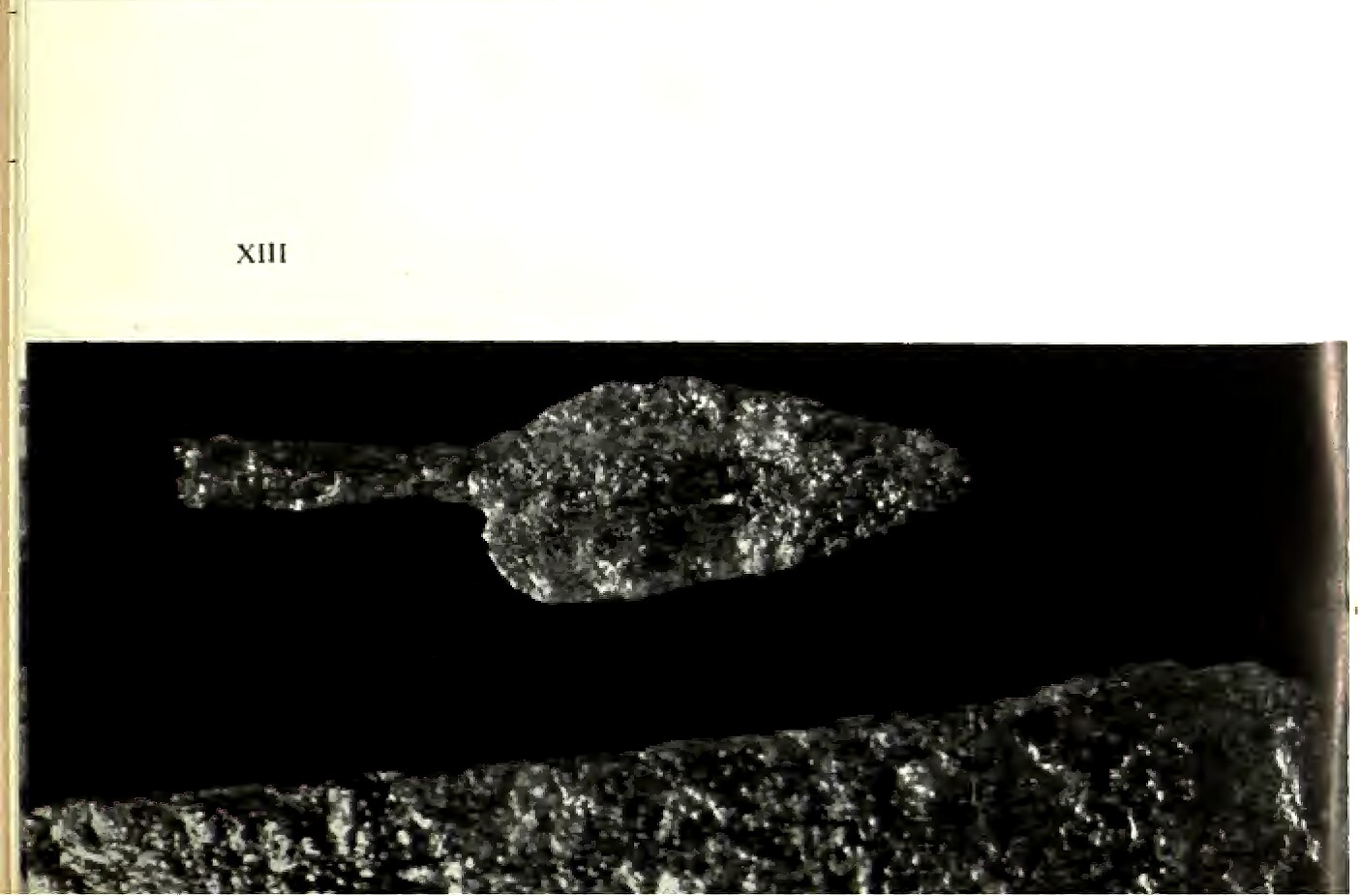
What caused it? We do not know. Invasion by incoming groups is one possibility — the first millennium BCE saw major population movements associated with iron-using cultures spreading eastward through the subcontinent. Environmental change is another possibility: the Ajay’s hydrology has shifted significantly over three millennia. The conflagration itself might have been deliberate or accidental.
What we can say is that the Chalcolithic culture of the Rāṛh — the black-and-red ware, the copper tools, the rice-farming villages — ends. And when the historical record picks up again in this landscape, it is a different world: iron-using, eventually Indo-Aryan-speaking, eventually Buddhist.
The people who had lived here did not vanish. But they were displaced, absorbed, pushed westward into the uplands — into what is now Jharkhand and western Odisha — or absorbed into the emerging social hierarchy as the lowest strata. The Munda-speaking communities of Jharkhand, Odisha, and Chota Nagpur are, in a meaningful sense, the heirs of Pandu Rajar Dhibi who went one way. The Bengali-speaking lower castes of the Rāṛh are, in a meaningful sense, the heirs who stayed — and were absorbed.
The Eastern Delta and the Sea
Before closing, a contrasting data point from the opposite end of Bengal’s geography.
Wari-Bateshwar, in Narsingdi district of present-day Bangladesh — the eastern delta, river-fed and flat, the antithesis of the Rāṛh — was an Iron Age site occupied roughly from 400 to 100 BCE. Excavations by Jahangirnagar University from 2000 onward revealed an industrial-scale bead-making operation: semi-precious stone beads — agate, carnelian, chalcedony, amethyst — produced here in large quantities, and found in archaeological contexts as far away as the Philippines and Indonesia.
Bengal was not just a recipient of maritime connections. It was a producer. It was exporting luxury goods by sea to Southeast Asia during the mid-first millennium BCE. The sea-lanes that the Munda ancestors may have used to arrive on the Odisha coast were also the sea-lanes that Bengali merchants used to trade eastward.
The Bengal of 2,400 years ago was a maritime civilization with deep connections across the Bay of Bengal. This will matter when we reach the story of champa and the kingdoms of Southeast Asia later in this series.
The Rāṛh as Continental Geography
One more thing before the train pulls into Bolpur.
The Rāṛh laterite is not narrowly Bengali. It is geologically continuous with the Odisha uplands to the south — the same Precambrian basement rock, the same lateritic weathering, the same ochre-red soil. When the Chalcolithic farmers of the Ajay valley were planting rice, their cousins — or neighbors, or trading partners — were doing similar things in the Suvarnarekha valley of what is now Odisha, in the uplands above Bhubaneswar, across a landscape that modern state boundaries have divided but that was, ecologically and culturally, one territory.
The Sora and Saura people of central Odisha — Austroasiatic speakers closely related to the Munda communities — are the parallel substrate community of that world. They are still there. Their language is still spoken. And at the Jagannath temple in Puri — the largest Hindu pilgrimage site in eastern India — the Daitapati priests, who hold the deepest ritual functions in the inner sanctum, are traditionally from the Sabara (tribal) community. At the heart of one of the subcontinent’s great Brahmanical pilgrimage traditions, the people with the oldest ritual authority trace their lineage to the pre-Aryan substrate of Odisha.
The point for now is this: the deep history of Bengal is not narrowly the deep history of Bengal. It is the deep history of the eastern plateau — a landscape spanning what are now three Indian states and Bangladesh, inhabited for at least 3,600 years by communities whose descendants are still here, and whose words, genes, and farming practices are still with us.
The People in the Market at Bolpur
The Santal farmers you can still see in the weekly market at Bolpur — selling vegetables, baskets, mahua flowers — carry something very old with them. Their faces, their language (Santali, written now in the Ol Chiki script developed in the 1920s by Pandit Raghunath Murmu), their rice-farming practices: these are continuous with what the excavations at Pandu Rajar Dhibi have revealed.
They are not museum pieces. They are not remnants. They are living people with contemporary lives and contemporary political struggles — Santali-medium schools remain underfunded, land rights are contested, the Santal Parganas carries its history of rebellion and dispossession into the present. But they are also, in a very literal sense, the people who were here first. Whose agricultural vocabulary Bengali borrowed. Whose genetic lineage runs through Bengali Dalits and low-caste communities. Whose civilization left the mounds that archaeologists found under the red earth.
Bengali is a language spoken by people who came later, built on a foundation laid by people who were already here. The red soil the train passes through is that foundation. And it is worth knowing what you are standing on.
Sources
- Paresh Chandra Das Gupta. Excavations at Pandu Rajar Dhibi (1962). Directorate of Archaeology, West Bengal. 105 pp. ↗
- Vagheesh Narasimhan et al.. "The Formation of Human Populations in South and Central Asia". Science (2019). Vol. 365, eaat7487 doi:10.1126/science.aat7487
- David Reich et al.. "Reconstructing Indian Population History". Nature (2009). Vol. 461, pp. 489–494 doi:10.1038/nature08365
- F.B.J. Kuiper. Aryans in the Rigveda (1991). Rodopi, Amsterdam. Vol. 1. ISBN 978-9051833072
- Paul Sidwell. "The Austroasiatic Language Family". The Oxford Handbook of the Languages of South Asia (2018). Oxford University Press. Ed. Cardona & Jain
- Michael Witzel. "Early Sources for South Asian Substrate Languages". Mother Tongue (ASLIP) (1999). Special Extra Number, Oct. 1999, pp. 1–70 ↗
- Sufi Mostafizur Rahman. "Prospects of Public Archaeology in Heritage Management in Bangladesh: Perspective of Wari-Bateshwar". Archaeologies (2011). Springer. Primary excavation reports: Jahangirnagar University, from 2000 doi:10.1007/s11759-011-9177-5
Next in this series: The Words That Don't Move